

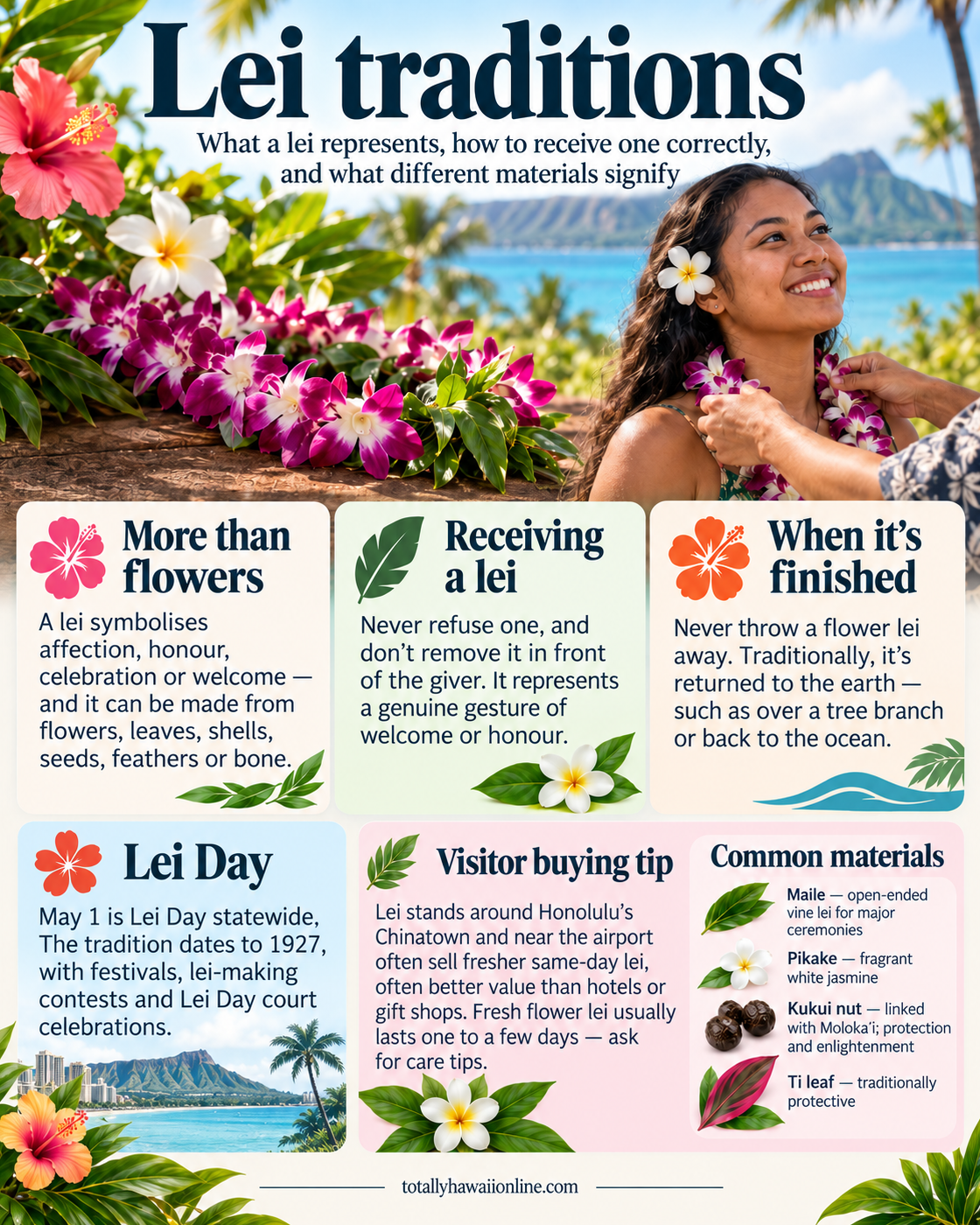
Lei are relationships made visible
A lei is a garland or adornment made from materials that can include flowers, leaves, shells, seeds and feathers. In Hawaiʻi it can mark affection, honour, celebration, remembrance, achievement or welcome. The important correction for visitors is that lei are not a generic “aloha costume.” They are made and given within living family, community and cultural practices, and the meaning comes as much from the person, occasion and materials as from the finished object.
Current Hawaiʻi Tourism Authority cultural guidance describes lei as a symbol of aloha, connection and love, while also noting that Native Hawaiian use and today's familiar welcome custom are not identical. That is a useful frame: respect the living tradition without pretending every modern lei exchange follows one ancient script.
Receiving a lei: gratitude matters more than performing rules
If someone gives you a lei, receive it with thanks and follow the giver's lead. It is commonly considered impolite to casually refuse a lei, but real people have allergies, sensory needs, religious boundaries and personal circumstances. Respect is not improved by forcing someone to wear plant material they cannot safely wear.
GoHawaii's traditions guidance also notes that historically a lei could be tied around the neck rather than dropped over the head, reflecting respect for the head and back. Contemporary presentation varies. I would not correct a local giver's method based on something I read online; I would simply stand still, accept the gesture and say mahalo.
When you need to remove it
Do not toss a lei on the floor or into a rubbish bin as though it were disposable party decoration. Enjoy it, display it, dry or preserve it if appropriate, or return biodegradable plant material thoughtfully. If the lei contains string, wire, ribbon, plastic, pins or non-native material, remove those components rather than placing the whole item into the ocean or natural habitat. “Return it to nature” is not permission to litter or introduce material where it does not belong.
Lei Day: 1 May
May 1 is Lei Day in Hawaiʻi, a modern tradition established in the 1920s and still actively celebrated. Competitions, demonstrations, music and community events highlight the artistry of lei rather than treating them as an airport cliché. If your trip overlaps May 1, look for the current local programme instead of assuming one statewide timetable.
Materials do not have one universal tourist dictionary
Flower, maile, ti leaf, shell, seed and feather lei can carry associations tied to place, person, lineage, ceremony and maker. Avoid websites that assign a single fixed emotion to every plant as if lei were a colour-coded gift chart. The Hawaiʻi Tourism Authority notes the thoughtful selection of materials for symbolism, seasonality and relationship to ʻāina; the person making or giving the lei is the best source for what a specific piece means.
Feather lei are a specialist art in their own right. Bishop Museum's current living-culture programmes show hulu practitioners teaching techniques through lineages of kumu and apprentices, which is a much better way to understand the craft than calling every feather adornment a souvenir.
Buying a lei: choose the maker before the photo
Oʻahu's historic Chinatown remains a well-known place to find lei makers and shops, and workshops are offered around the islands. Ask what material is being used, how to keep it fresh, whether refrigeration is appropriate and how long it should reasonably last. For a graduation, wedding, memorial or other meaningful event, tell the maker the occasion rather than choosing only by colour.
If you join a workshop, treat the practitioner as a teacher, not as a prop for content. Ask before filming close-up instruction, follow guidance on handling materials, and expect that a beginner workshop teaches a technique rather than conferring cultural authority.
Pregnancy and other family-specific customs
You may hear a custom that a pregnant person should receive an open-ended lei rather than a closed loop. Hawaiʻi tourism cultural material documents that belief as one practice. It is not a reason for a visitor to police another family's lei. If you are buying for someone and the point matters, ask the recipient or the lei maker what is appropriate.
The visitor version I trust
- Receive a lei with gratitude and follow the giver's lead.
- Keep it off the floor and out of the rubbish while it is still meaningful or usable.
- Ask the maker about materials and occasion instead of inventing symbolism.
- Dispose of it in a way that respects both the gift and the environment.
- Remember that learning one technique does not make you the authority on the tradition.
Cheers, Carpe Diem & wear the aloha without turning it into a costume! 🍻⏳🌺
TATS Man
Your lei-etiquette myth filter